
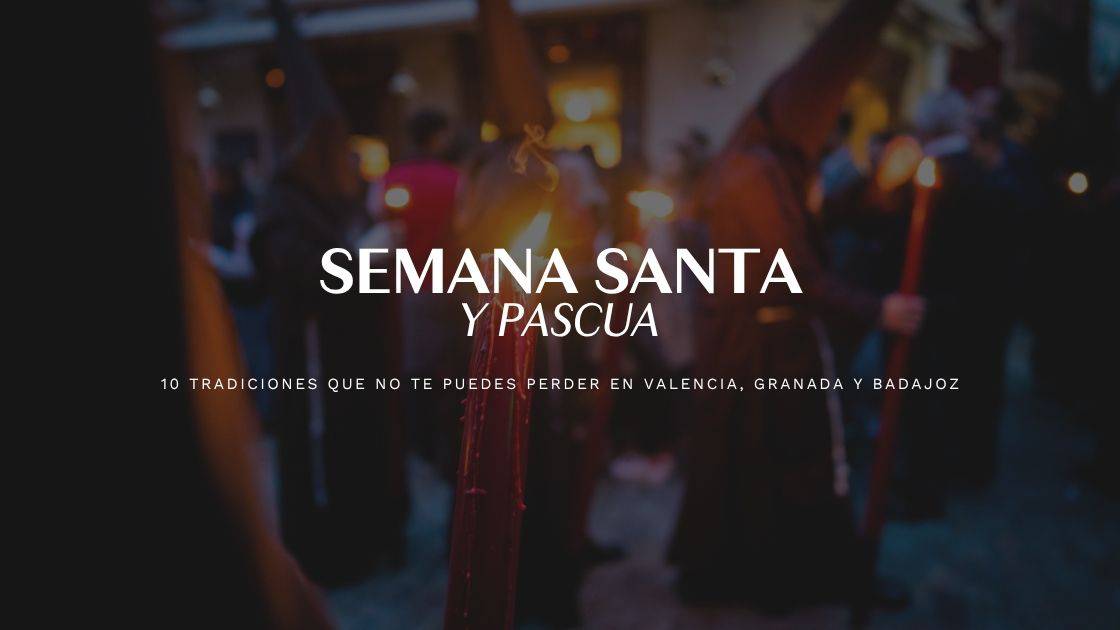
Three cities, one shared feeling
Easter Week isn’t experienced the same way everywhere. And that’s exactly what makes it special.
In Valencia, Granada and Badajoz, it’s not just the setting that changes. It’s the way it’s felt. The rhythm. The sound. Even the silence.
But there’s something they all have in common: that feeling of being part of something deeper than what you’re seeing. Something that stays with you.
And that’s where the real journey begins.
Valencia: where tradition meets the sea
In Valencia, Easter Week has something you won’t find anywhere else: the sea as its backdrop.
In the neighbourhoods of Cabanyal and Canyamelar, everything feels close, almost as if you’ve been part of it all along. Open balconies, neighbours taking part, streets full of life without losing their essence.
One of the most moving moments comes on Good Friday, when the procession reaches the shoreline and the sea becomes a place of farewell and remembrance. You don’t need to understand every detail to feel it.
And when the most solemn moments are over, Easter brings a lighter atmosphere. Brighter. More spontaneous. Families gather outdoors, kites fill the sky and simple traditions take over: sharing time without looking at the clock.
Granada: emotion you can hear and feel
Granada changes during Easter Week. And it’s not just because of the processions. It’s something in the air.
The streets of the Albaicín, the hills, the night light… everything enhances the experience.
There are moments that can’t quite be explained, like when a saeta (a traditional flamenco-style chant) suddenly breaks the silence from a balcony. Or when a procession moves slowly through the city while everything else seems to pause.
And then there’s Sacromonte. Here, tradition and culture come together in a truly authentic way. Nothing feels staged. It simply happens. And you feel like you’re experiencing the real Granada
Badajoz: silence, respect and goosebumps
In Badajoz, Easter Week is experienced differently. More restrained. More intimate. But just as powerful.
Here, silence plays a leading role. And when everything quiets down, every detail becomes more intense: a step, a glance, a voice appearing out of nowhere.
The saetas, sung without warning, are one of those moments that stop you in your tracks. Whether you’re religious or not, there’s something deeply moving about them.
And when the week comes to an end, everything shifts. Easter Sunday brings light, music and a completely different atmosphere. It feels like the city finally exhales.
Traditions that are shared (and tasted)
If there’s one thing these three cities share, it’s the way people come together.
Because Easter Week is also experienced around the table.
During these days, traditional recipes take centre stage. Simple dishes, but full of meaning. Sweets that only appear at this time of year. Flavours that may vary from one place to another, but all have something in common: they invite you to slow down and enjoy.
And in the end, that’s part of the experience too.
Tips to experience Easter Week like a local
You don’t need to see every procession or understand every detail to enjoy it. In fact, sometimes it’s better not to.
- Arrive without rushing and let yourself go with the flow
- Choose one spot and stay there instead of trying to see everything
- Mix quiet moments with more intense ones
- Ask locals – people are usually happy to share what it means to them
Because some things aren’t planned. They’re discovered.
What to see during Easter Week: key dates, times and locations
If it’s your first time, this is where things become easier. Knowing when to go and where to stand makes all the difference.
Here’s a simple guide to help you enjoy each city without feeling overwhelmed.
Valencia
Everything takes place in Cabanyal-Canyamelar, right by the coast. It’s a more intimate, neighbourhood-style Easter Week.
Maundy Thursday – 2 April
🕒 23:45 – Procesión de las Antorchas
📍 Cabanyal-Canyamelar
Why go:
The combination of night, torchlight and atmosphere makes it one of the most memorable moments.
Good Friday – 3 April
🕒 08:00
- Tribute to those lost at sea
📍 Playa de las Arenas
🕒 18:30 – 23:30 aprox.
- Procession of the Holy Burial
📍 Playa de las Arenas & Calle de la Reina
What to expect:
Morning is quieter and more intimate. Evening builds into the main event.
If it’s your first time, don’t miss the Holy Burial procession.
Easter Sunday – 5 April
🕒 13:00 – Procession of the Encounter (petal shower)
📍 Avenida del Mediterráneo
A different kind of moment: Brighter, more joyful and full of life. A beautiful way to close the week.
Granada
Granada’s Easter Week unfolds over long hours. Planning your timing is key.
Maundy Thursday – 2 April
🕒 15:45 – 05:40
📍 Main processions (all passing through the official route in the city centre):
Throughout the afternoon and evening, several brotherhoods make their way through the city, passing along the official route in the historic centre:
- La Concha → 15:45 – 23:59
- Redención y Salud → 16:45 – 02:15
- Perdón y Aurora → 16:30 – 02:35
- La Estrella → 17:15 – 03:35
- Silencio → 00:00 – 05:40 (madrugada)
What to keep in mind:
The city centre gets very busy from 18:30 onwards, so it’s best to arrive early or find a quieter nearby street.
Late at night, the atmosphere becomes more solemn. The Silencio procession, in the early hours, is particularly moving.
Good Friday – 3 April
🕒 13:45 – 01:15
📍 Realejo y center
Es el día más completo. Prácticamente no hay pausa.
- Hora Nona → 13:45 – 16:00 (Realejo area)
- Ferroviarios → 16:00 – 00:45
- Escolapios → 18:20 – 00:45
- Los Favores → 18:45 – 01:10
- Soledad San Jerónimo → 18:15 – 01:15
- Santo Sepulcro → 20:00 – 00:15
Tips for the day:
- Head to Realejo earlier in the day
- Focus on the city centre in the evening
- This is the most intense and solemn day
Holy Saturday – 4 April
🕒 17:00 – 01:30
📍 From la Alhambra
- La Alhambra → 17:00 – 01:30
What makes it special:
A quieter day, ideal if you prefer fewer crowds. The procession descending from the Alhambra is particularly striking.
Easter Sunday – 5 April
🕒 10:30 – 18:15
- Facundillos → 10:30 – 14:40
- Resurrección y Triunfo → 11:00 – 18:15
- Resucitado y Alegría → 11:10 – 15:20
What to expect:
A more relaxed, festive atmosphere. Perfect if you want to experience Easter Week in a lighter way.
Badajoz
Badajoz is best experienced slowly. The more you pause, the more you notice.
Maundy Thursday – 2 April
Brotherhood: Jesús de la Humildad y Paciencia / Ecce-Homo / Virgen de la Soledad
🕒 Departure: 17:30 – Ermita de La Soledad
🕒 Official route: 20:00 – Plaza de España (Cathedral)
Best spots:
- Plaza de España
- Narrow streets with tight turns
- Calle Francisco Pizarro
Good Friday – 3 April
Brotherhood: Santo Entierro / Virgen de las Lágrimas / Santiago Apóstol
🕒 Departure: 17:30 – Parroquia de San Agustín
🕒 Official route: 20:00 – Plaza de España
👉 Recommendation:
One of the most solemn moments. Plaza de España and Plaza de la Soledad are ideal viewing points.
Easter Sunday – 5 April
Brotherhood: Cristo Resucitado / Virgen de la Aurora
🕒 Departure: 11:30 – Parroquia de San Agustín
🕒 Arrival: 13:00 – Plaza de España
👉 Don’t miss:
- Calle José Terrón (petal shower)
- Plaza de España (the encounter)
This is where everything shifts. Where silence gives way to light.
Easter Week isn’t just something you see while travelling. It’s something that, if you let it, you end up feeling. Each city reveals it in its own way. Valencia, with its light and the sea. Granada, with its intensity. Badajoz, with its calm. And somewhere between processions, streets and small moments, something appears that can’t always be explained, but is always remembered.
Because some journeys aren’t measured by what you do, but by how they make you feel. And this is one of them.